
Madame Marie Curie was the famous scientist known for her work in radioactivity. She was the first woman to win a Nobel Prize, and the only person to win Nobel Prize in two different Sciences.
Marie Curie
Marie Curie was born on 7 November 1869 in Warsaw, Poland. Her real name was Maria Sklodowska. She was a famous physicist, chemist, and scientist known for her work in radioactivity. She was the first woman to win a Nobel Prize in physics in 1903 with her husband, Pierre Curie and Henri Becquerel. She is the only person to win Nobel Prize in two different science – Physics and Chemistry. She was the first woman Professor at the University of Paris.
On 4 July 1934, Marie Curie died at the age of 66 due to aplastic anaemia. She was too much exposed to the radiation in her laboratory. Or that time there was no protection against the effects of radiation.
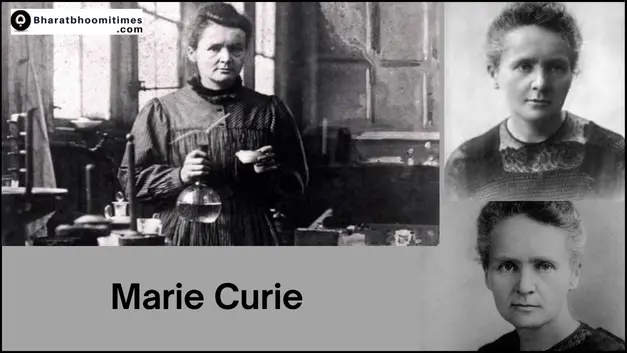
Madame curie: Early life and Education
Maria Sklodowska was born in Warsaw, Poland on 7 November 1867. Her original name was Maria Solomea Sklodowska. She was the youngest of five children in a family that highly valued education. Her father was a maths teacher, but he left his job due to Russian control over Poland. It became difficult to fill the needs of their family, so they rented half of their house to students. Her mother was a school teacher, she resigned after Maria was born.
When Maria was 10 years old, her mother died of Tuberculosis. Less than 3 years earlier, Maria’s oldest sister Sofia, died of Typhus contracted from one of the students living in their rented house. After this, she has a great interest in Physics, she was the toppers student in her school classes. She graduated at 15 with a gold medal. After a collapse due to depression spent a year with her relatives. She started tutoring so she could earn money to go to school in Paris, France.
But due to low money, there was a deal between her sister, Bronia and Curie that she would work to support her studies while she was in school, and Bronia would return the favour after she completed her studies. For 5 years, Curie worked as a tutor and used her spare time to study, reading about physics, chemistry and maths.
Scientific Career
She left Poland and went to France with the support of her sister Bronia. Marie enrolled at the Sorbonne and continued her studies and obtained Licenciateships in Physics and the Mathematical Sciences. Due to little money, Marie Curie survived on buttered bread and tea, and her health became bad due to poor diet. She focused so hard on her studies that she sometimes forgot to eat. Curie completed her master’s degree in Physics in 1893 and another degree in mathematics. She started working in Lippmann’s research laboratory. In 1894, she was placed second in the licence of mathematical science.
Marie Curie: Married life
On 25 July 1895, Marie Curie married a French physicist, Pierre Curie. She became Marie Curie after moving to France and marrying French scientist Pierre Curie. She adopted the French version of the name ‘Marie’ and took her husband’s surname ‘Curie’. They both are a brilliant pair and they become a scientific dynamic duo. They set up a joint laboratory in the basement, building their own equipment for their experiment.
Marie Curie Inventions
Curie and Pierre Curie investigated the theory of Radioactivity. Curie coined the word ‘radioactivity’. At that time, no one knew about their effect of radioactivity on the body, so they performed the research without any precaution or protective clothing. Till now, Madame Curie’s notebooks are still so radioactive that they have to be kept in a lead-lined box and handled only while wearing protective clothing.
In 1898, madam curie and his husband discovered two new radioactive elements: ‘Polonium’ (named after Marie’s homeland, Poland) and the second element ‘Radium’. It is one of the most radioactive and dangerous metals.
Marie Curie Nobel Prizes
Madame Curie’s contribution to science where Revolutionary and widely recognised. In 1903, she shared the Nobel Prize in physics with Pierre Curie and Henry Becquerel for their work on radioactivity. Three was the first woman to win a Nobel Prize in physics.
On 19 April 1906, Pierre Curie died in a Paris Street accident. After her husband’s death, she was appointed as the First woman Professor at the University of Paris.
In 1911, Marie Curie won her second Nobel Prize for chemistry for her discovery of Radium and polonium and her work on the isolation of Radium. This made her the first person ever to win a Nobel Prize in two different streams: Physics and Chemistry.
Also, Check
GATE 2026
CLAT 2026
CTET 2025
Marie Curie Death
During World War I, Marie Curie applied her knowledge to save lives. See developed mobile X-ray units- called ‘Little curies’. It is used to diagnose soldiers who are injured on the Battlefield. She trained nurse and personally drove the mobile unit to the front line. She played a key role in medical innovation.
Marie Curie died on 4 July 1934, due to a disease known as aplastic anaemia. It is a condition developed after years of exposure to radiation through her work. Even in death, her scientific materials and personal belongings remained radioactive for decades.
Despite Curie’s biggest contribution to science, she faced challenges as a woman in science. She was overlooked by a male-dominated Institution and had to fight for the position and recognition.
FAQs on Marie Curie
Who was Marie Curie?
Marie Curie was a polish French scientist known for her research on radioactivity. See was the first woman and only person to win a Nobel Prize in two different scientific fields -Physics and Chemistry.
What did Marie Curie Discover?
Marie Curie Discover to Radioactive elements: polonium and radium in 1898. Which is now greatly used for the study of nuclear science and medicine.
What are Marie Curie’s major achievements?
She want to Nobel Prize, first in Physics (1903) and second in chemistry (1911) and she was the first female Professor at the University of Paris.